I am of the opinion that during our years of speculative freemasonry, we have lost interest on what are goals are and what we are supposed to be doing as a masonic entity.
I once asked a group of masons what they defined as "work" in the masonic context, many yelled out community service and degree-work. I fail to see how that be defined as masonic since I can join any community organization and serve. Moreover, it makes no sense that we call degree-work actual work when some of our lodges are so sloppy with it and even more importantly, most of the men we initiate are leaving with no goodbye notes, but that's another story.
So what do I think the goals of our organization are? Well frankly they are in the answer to the question stated above, if you are familiar with the Preston-Webb version of the ritual of course.
The question of subduing comes into play when within our organization we have a lash of egocentric, greedy and malicious members who turn our great organization into their political playground or pet project for their own means. Some want to turn the organization into an opportunity to "network" with the females in the auxilliary bodies, some want to turn their lodges and masonic bodies into cliques and mini - biker clubs. Some just want to use it as an excuse to leech away money from their organizations into their own bank accounts, some just want it to exercise a lack of power they suffer in the real world and they desperately need a boost of ego. Our goal in freemasonry is to first start with the individual coming in: what are your vices? what are your goals? how do you exercise temperance and prevent yourself delving into the excesses of what your vices afford? Those are the key questions one has to ask to the candidate on entering the temple, because once he has entered, that's another ball game. I have seen so many men change personalities (or rather reveal themselves and their true intentions) as soon as they become masons. Right off the petition, these men need to be properly examined so we can ensure that their passions are within control of themselves and they don't drag our organization down because of their excesses.
Now what can this organization do to the good man with controllable vices who wishes to become better? Why...with the lessons our craft teaches, any good man can become better. That is the truth. The questions are: are these lessons being taught to the man not only as he tries to enter the temple but while he is in it? is he able to understand and interpret what is being taught to him through the metaphors and allegories of freemasonry? Most importantly, does he have the ability, willingness and desire to apply these lessons he has learned into his own life? Is he a shining example of an imperfect man sieving away his impurities in order to become a more perfect person under the sight of God to his family and his community?
At the end of the day, the goal of our fraternity is far from just being a community service organization ( there are many organizations that do that ). Our goals within this organization are primarily character development and leadership training using the allegories the craft provides and the structure it allows so that its members can be more responsible members of the community.
February 2, 2014


October 13, 2013
Is there no help?
Just wanted to say this before I get into the main point of this post: I honestly believe we need to pay more attention to our mental health than our physical health. If you look at the tragedies of late, you'd have noticed a lot of these terrible tragedies could have been prevented if we had a real way of dealing with patients of mental health. Drug abuse, substance abuse, PTSD, etc are all mental conditions and they need to be treated by licensed professionals. The problem is that there are too many of these professionals who are too quick to prescribe you on some medication and send you on your way, or the costs of seeking such help is too high. Hopefully with the healthcare reform, this can be addressed. In the meantime we suffer from a society that has a relatively low priority and even a stigma on those who suffer from mental health conditions. They are not any different from me and you, they just need a little bit more help. And for those like me who suffer or have suffered with such mental ailments, please do not ignore the signs. Go seek proper help.
Now that I've got that out the way, let me bring it to the context of freemasonry.
A while ago, I read about a brother who committed murder-suicide. He left a note that got me thinking what the real purpose of our fraternity is. In the past year, I have talked to many brothers who have been through a lot: job loss, financial troubles, child custody troubles, marriage trouble, divorce trouble, drug abuse problems, alcohol problems etc. These brothers confided to me about in secret and in confidence, but I wonder: why not address this in front of a lodge of your so-called "brothers"?
Trust me, I have had my share of being in front of that altar asking for help, and got chewed out. Granted I understand their mindset at that point in time, but at that time I needed help. I've not gone in front of a lodge or asked my lodge for help ever since. I'm sure there are many with similar stories, and hopefully they won't go to the extent as our brother in California did.
So at the end of the day, if we can not follow up with what we learned on getting raised as Master Masons and be our own brothers keeper, then my question is: what is the use of our fraternity? If we can not call on a brother for help or at least a listening ear, or some wise words of counsel, or just a person who can hear our deepest thoughts without judgment or reservation, what are we in this fraternity for?
What is the purpose of "making good men better" if we can't help good men who go through bad times? What is the essence of calling another man a brother if I can't treat him as such? What do I gain from a lodge that wants to disavow me when I go through troubles even when I have invested in it so much with all that i have got? What use is it if I can't call a brother a friend?
Some of us get lost in the battle of politics, titles and the social superficialities that embellish our fraternity and often forget about one basic principle: we are our brother's keeper. We need to start raising not just masons, but brothers. We need to start reaching out and keeping our brothers close. We need to make our lodges closer and more intimate than the lodges of 200 people with only 10 people showing up. We need to make our bonds between ourselves and our families closer. That's what we really need to do: be our own support.
As men, we are more inclined to secluding ourselves in times of trouble: internalizing our frustrations and hardships and troubles and dealing with them in our heads. As much as we need to move forward and fix things, we need to learn how to have a healthy outlet. We need to learn to find those people around us who can help us become better and help us and be our pillars when we are weak. We need brothers, not masons. We need to start making them. We need to start becoming one.
Now that I've got that out the way, let me bring it to the context of freemasonry.
A while ago, I read about a brother who committed murder-suicide. He left a note that got me thinking what the real purpose of our fraternity is. In the past year, I have talked to many brothers who have been through a lot: job loss, financial troubles, child custody troubles, marriage trouble, divorce trouble, drug abuse problems, alcohol problems etc. These brothers confided to me about in secret and in confidence, but I wonder: why not address this in front of a lodge of your so-called "brothers"?
Trust me, I have had my share of being in front of that altar asking for help, and got chewed out. Granted I understand their mindset at that point in time, but at that time I needed help. I've not gone in front of a lodge or asked my lodge for help ever since. I'm sure there are many with similar stories, and hopefully they won't go to the extent as our brother in California did.
So at the end of the day, if we can not follow up with what we learned on getting raised as Master Masons and be our own brothers keeper, then my question is: what is the use of our fraternity? If we can not call on a brother for help or at least a listening ear, or some wise words of counsel, or just a person who can hear our deepest thoughts without judgment or reservation, what are we in this fraternity for?
What is the purpose of "making good men better" if we can't help good men who go through bad times? What is the essence of calling another man a brother if I can't treat him as such? What do I gain from a lodge that wants to disavow me when I go through troubles even when I have invested in it so much with all that i have got? What use is it if I can't call a brother a friend?
Some of us get lost in the battle of politics, titles and the social superficialities that embellish our fraternity and often forget about one basic principle: we are our brother's keeper. We need to start raising not just masons, but brothers. We need to start reaching out and keeping our brothers close. We need to make our lodges closer and more intimate than the lodges of 200 people with only 10 people showing up. We need to make our bonds between ourselves and our families closer. That's what we really need to do: be our own support.
As men, we are more inclined to secluding ourselves in times of trouble: internalizing our frustrations and hardships and troubles and dealing with them in our heads. As much as we need to move forward and fix things, we need to learn how to have a healthy outlet. We need to learn to find those people around us who can help us become better and help us and be our pillars when we are weak. We need brothers, not masons. We need to start making them. We need to start becoming one.
Prince Hall: A man with initiative

Two weeks ago, Prince Hall masons all over the world celebrated the 229th anniversary of the issuance of the charter of African Lodge #459. All throughout September, Prince Hall masons may have had processions and parades, decked out in their usual masonic regalia. They must have marched up into their churches (I can't understand why we have to celebrate such a day in churches instead of lodge halls, but I digress) and listened to their Grand Officers and Church clergymen talk loud and throw out so many masonic references and anecdotes that one may just need to replay the speech from the last year and not need to attend the one this year.
With the Prince Hall story, there are lot of misinformation and falsities that has been spread from the time of Joshua Woodlin to William Grimshaw to every other ignorant brother who has failed to pick up a copy of either of two books by Charles Wesley or Joseph Walkes or articles like this on the Phylaxis website. There's the fable most older members misinform newer members relating events that happened in 1773-4 to something that happened in 1784. Once again, I digressed. It is always annoying every year the same misinformation gets spread especially into the minds of novice and younger members who are too lazy to do their own due diligence and research.
Anyway, where was I?
So on September 29, 1784, Prince Hall received a charter from the Premier Grand Lodge of England (Moderns) to practice Freemasonry in its full form. But how did this come about?
We recall that on March 6, 1775, Prince Hall and fourteen other men of color were raised in an Irish Constitution Lodge on Castle Island. Now these men were given a dispensation to just do really two things: bury their dead, and march on St. John's day. THAT WAS IT!
Anyone who knows freemasonry should know that this is not all we do as masons. I'm quite sure Prince Hall was aware of the fact seeing as neighboring lodges were conferring degrees and travelling to other lodges and what not.
So what did Prince Hall and those masons of African Lodge do? They were not going to be complacent by being called masons alone, they were going to search and sojourn and work for the right to become masons in full: taking advantage of all the full benefits of being a mason and not just showing off in their masonic regalia in public without doing any work.
That initiative to be more than a mason by name led to Prince Hall writing letters to a Worshipful Master in England by the name of William Moody. By his help and liaison with Wm Moody and persistence in his follow-up with him before and after the issuance of the charter (there was an unknown delay in Prince Hall receiving the charter for 3 years, but that's another story) Prince Hall and those brothers of now African Lodge #459 were better enabled armed with their tools and a proper dispensation to work and over 200 years later, Prince Hall masons are still at work courtesy of the initiative and drive of Prince Hall and those masons of #459.
So, what can we learn from the Prince Hall story?
Prince Hall and those men of #459 were men with initiative. They knew that freemasonry was a wide world outside of the confines of what their grand lodge had squeezed them into and dictated they do. They were more than that and they knew it. They fought their way into getting a charter and defending that charter for the purpose of exploring the wide world of freemasonry. A wide world that would eventually spread literally all over the globe with Prince Hall Lodges from Hawaii round to Japan.
We have grown too complacent in being masons by name alone. We'd rather just march in public and wear regalia and look pretty but not do what it takes to expand our knowledge. We should garner some initiative and travel as far and as wide as we can gaining knowledge. We should fight to remove restrictions set forth by our lodges and grand lodges that impede our expansion. We should foster and go forth and teach our members the real story of Prince Hall Freemasonry. We should give them the motivation to go out there and find out new knowledge and research on their own. We should be working men building up each other and making our community better by our existence. We should have some initiative to prosper and expand outside the little constrictive world we call Prince Hall Freemasonry. Freemasonry in itself is a universal fraternity, we should explore our masonic universe.
That is what I think Prince Hall's story teaches us.
October 6, 2013
Masonic Pet Peeves
I hate being called "square". Why don't you call me plumb or level? Why square? Who taught us that stupid stuff?
I hate seeing brothers talk and garble on some fluff. You see it all the time in forums as well as in person. Brothers practicing for the title of the MOST WORSHIPFUL MASTER OF THE GRAND LODGE OF THEIR MINDS. It's almost as if they shouldn't even bother talking because when you have to write a summary of the 20 minute or 100-word garble they just uttered, it might just end up being..."I don't know what in the hell he was talking about"
I hate seeing brothers think that freemasonry is the "Father of all BGLO's" They need to do their research and stop talking about what they don't know. Seriously, they need to shut up.
I hate being a witness to poor ritual. Even if it's just a mis-step, I shriek, and I grind my teeth, and my OCD kicks in to correct that mis-step immediately. I thought this was a behavior reserved only for Past Masters...
I hate seeing brothers throw the "L". Technically your thumb and your index finger make an L, not a square. Your thumb is not the same length as your finger (or you're just weird). Moreso, it goes back to the "square" reference. Who was the idiot who invented that? Furthermore, are we some sort of gang? Why do younger people (in particular black people) feel the need to always represent everything they are?
I hate gaudy show off of masonic paraphernalia. I just have an old masonic t-shirt, and small items (such as a ring, a lapel pin and a wrist band) which I wear sparingly. Brothers try to "shine" with wearing jackets with 20 or 30 masonic symbols on them. They drive around with their rear view mirrors almost covered in masonic emblems. Is all that really necessary? Our foreign brothers have way more discretion because of their environment. I do wish we followed their lead and not be so showy.
Finally, I hate the politics. Many times I sit in a convention or meeting or program were a man (typically a high officer of some sort) makes a speech and the next 3-3 million speakers right behind him tell us how great his speech was and how great the man is and how honored he is to be a friend of his and yadda yadda. I hate that simple things that could possibly uplift the craft and the fraternity are subject to the egos, envy and eventual sabotage from such politically enabled men. It's just sad to see how some can't put everything all aside and get on a level and avoid the political rubbish and get things done. I understand with any organization or hierarchy of people, politics is a necessary evil, but this is freemasonry, you sort of expect more, but you get less. It's sad and it hurts and gets on my last nerves.
October 1, 2013
3-letter or 4-letter 5-letters
FAM AFAM FAAYM
All these letters have been used to describe Prince Hall Grand Lodges at one point or the other in the history of Prince Hall Freemasonry. Yet, we still have a lot of ill-informed brothers using the “3-letter, 4-letter” system to determine the Masonic legitimacy of Grand Lodges. Is that correct? The broad answer is no, but there are exceptions which would be discussed later.
Firstly, let us discuss the “3-letter, 4-letter” drama in more detail. The comparison is between the F&AM Grand Lodges and the Grand Lodges tagged as AF&AM, but where do these letters come from?
The story starts about 1717 when the “Premier Grand Lodge of England” was formed (popularly known as the Moderns). The Most Ancient and Honourable Fraternity of Free and Accepted Masons was formed in England beginning the realm of speculative freemasonry as we know it today. This Grand Lodge is the same grand lodge that will about 60 years later grant Prince Hall and several other colored masons of Boston a charter to warrant a lodge (African Lodge #459), the lodge effectively beginning the class of Prince Hall Freemasonry that is popular not only within the continental United States but all over the world. I digress.
In 1751, due to a schism (probably caused as a result of cultural differences between English masons and those of Irish and Scottish descent), another Grand Lodge was formed as the Grand Lodge in London of Free and Accepted Masons According to the Old Institution popularly known as the “Antients”. That Grand Lodge went ahead chartering various lodges including some in the United States of America.
They both merged in 1813 to form the United Grand Lodge of England, however the damage of the rift was done. Between 1717 and 1813, many lodges were formed in the United States that were either from modern or antient descent. As a result of the revolutionary war , a lot of these lodges lost contact with their English mother grand lodges and forming their own grand lodges holding their affiliations according to their lineage. So, for example the Grand lodge of Pennsylvania was AF&AM while a Grand Lodge of NY was F&AM.
Now, here’s the twist: Prince Hall Grand Lodges, for some reason, have a different history with regards to the use of F&AM, AF&AM etc. I have seen more than one grand lodge use it interchangeably over their history. Some chose to use F&AM because the charter to form African Lodge came from the “Moderns” Grand Lodge of England while some other GL’s followed the way of AF&AM due to Prince Hall being raised by the Irish (Antients). Also, one less told story about Prince Hall freemasonry was the formation of the National Grand Lodge of North America (Compact Masons) in 1847 which used the FAAYM tag. However, this Grand Lodge was officially dissolved in 1877, and all the Prince Hall Grand Lodges around the country all agreed around 1944 to use the tag of F&AM. Therefore, one can conclude that currently ALL regular Prince Hall grand lodges use the tag of F&AM.
However, like I said, there are exceptions. These exceptions are the clandestines e.g IFAAM (internationals) MFAM (Modern free) and the JGJ Grand Lodges (that inappropriately tag themselves as AF&AM). Bro Antoine Lilly did an awesome presentation on clandestine freemasonry which can be viewed here.
At the end of the day, the legitimacy of a grand lodge should never be determined by the number of letters tagged at the suffix of the grand lodge, rather by their lineage to regular masonic lodges or grand lodges originating from the Grand Lodge of England. We need to completely abandon the “3-Letter, 4-Letter” point as it’s completely incorrect.
July 19, 2013
My interpretation of the Masonic Structure

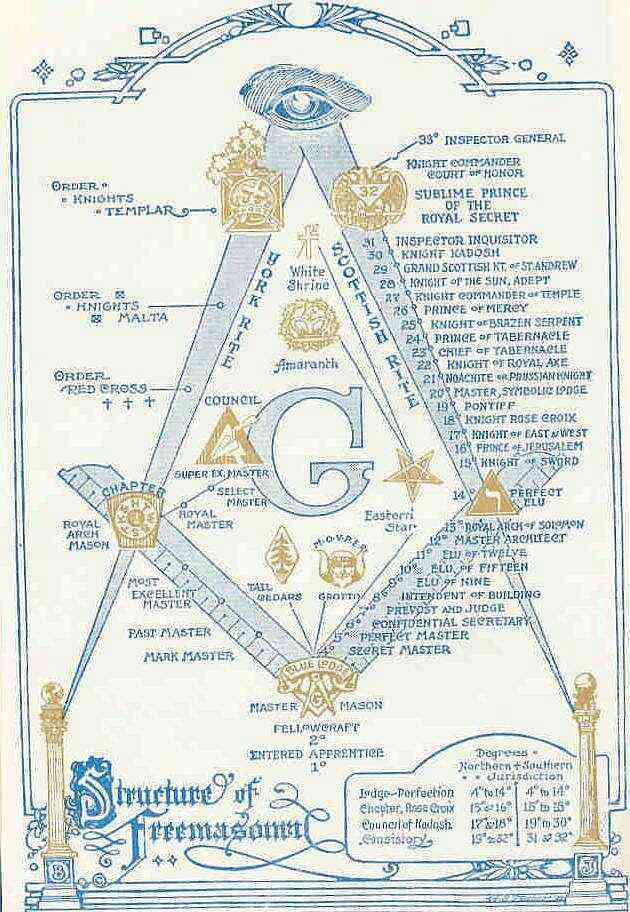
For years, many non-masons (and masons alike) have learned to use one or both of the images above as a means to describe masonic advancement per the various degrees that exist within freemasonry. As one may have noticed, there are a lot of organizations and degrees within the masonic body. Some have been described as adoptive, appendant, concordant etc.
In general, these structures somehow give a false impression which a lot of masons have carried on for years. An example of a false perception is this: being a 32 mason is higher than being a 3 mason. That is completely laughable, but it is a common misinformation spread not only among the profanes, but also masons alike.
These images have done a huge disservice in regards to properly educating all about the true structure of freemasonry, which is no secret. Perhaps it was just laziness that prevented anyone from making an accurate graphic depicting the structure of just the concordant bodies (appendants, allied etc are a different story since some are about to do away with masonic requirements anyway). Some have improperly categorized all those degrees and bodies that are above the third degree within the graphic as "higher degrees". Henry Wilson Coil in his Masonic Encyclopedia supports my conclusion when he said "Some oppose the term high degrees, because they dislike the implication that the Master's degree is not the highest, but the name is simple and convenient and its long usage would seem to preclude any possibility of avoiding it"
Laziness for short. I know people who walk around answering to titles longer than the first and last names of all their family put together.
In response to this problem of a masonic structure graphic, for a long time I have described it as some form of T-shape structure were regardless of where you are on either the scottish rite or the york rite or both: you are never higher than that of the master mason. Of course, I'm sure my brothers in the York Rite would disagree for reasons only known to master masons, but I'll say this: get suspended from your local lodge and see how your masonic portfolio comes crashing down...all the so-called "higher degrees" and all.
Anyway, I finally decided to put the graphic from my brain into a simple digital format all can see and review.

As you can see, there is no degree higher than that of a master mason according to it. What I have done also, according to my T-theory, is to extend the branch for both concordant rites. The more you advance on each side, the more detailed you are and the more knowledge you get a hold of. But in everything, we all meet on the same level. Sometimes that lesson flies above the heads of some of us.
What do you think?
May 10, 2013
Perception is reality
I always taught at a young age to "never judge a book by its cover". I have found out over the past week that this mantra, like many mantras I was taught in my childhood, is absolute rubbish.
Take a look around you, a credit score (regardless of inquiry into your financial situation) is used to determine if you're good enough for a car or a loan, a 2-3 page essay is often used to determine if you're good enough to attend a higher institution, a 15-20 minute interview is used to determine if you'll be a good fit for a company...there's a lot of judgment by perception going around in our society.
In ourperfect fraternity, we have ways to clear all doubt and ensure we are looking at the reality of a situation not its perception. .The concept is simply termed "due diligence", however this concept is lost on most of us. Investigation committees don't investigate, a brother is raised and brothers around do not choose to get to know a brother, but instead they judge him by his actions. They don't try to understand his background, his way of thinking, etc. They hear things, they don't try to ascertain for themselves and check facts, instead blindly believing what they hear.
That's just one of the shames of human nature that's brought into our fraternity. It is quite disappointing and I will confess that I am also a guilty party of this offense. But like I said it is human nature, one of my masonic mentors said it best "If every time I meet Gabe he's drunk, naturally I will assume he's an alcoholic. No matter what recommendations are made of him, my recommendation would be that he's a drunk"
My first college roommate taught me a saying about folks who make assumptions, but in the world we live in, that's just the reality of you and me. We just have to make sure we are making a good presentations of ourselves. It's something to strive to but often I imagine it may lead to a loss of self, and that bothers me because I like myself. However, in order to gain some things in life or go a far while, you have to lose some of yourself.
Take a look around you, a credit score (regardless of inquiry into your financial situation) is used to determine if you're good enough for a car or a loan, a 2-3 page essay is often used to determine if you're good enough to attend a higher institution, a 15-20 minute interview is used to determine if you'll be a good fit for a company...there's a lot of judgment by perception going around in our society.
In our
That's just one of the shames of human nature that's brought into our fraternity. It is quite disappointing and I will confess that I am also a guilty party of this offense. But like I said it is human nature, one of my masonic mentors said it best "If every time I meet Gabe he's drunk, naturally I will assume he's an alcoholic. No matter what recommendations are made of him, my recommendation would be that he's a drunk"
My first college roommate taught me a saying about folks who make assumptions, but in the world we live in, that's just the reality of you and me. We just have to make sure we are making a good presentations of ourselves. It's something to strive to but often I imagine it may lead to a loss of self, and that bothers me because I like myself. However, in order to gain some things in life or go a far while, you have to lose some of yourself.
Subscribe to:
Posts (Atom)